
Let me tell you something we have all experienced. You finish your 12th board exams with Physics, Chemistry, and Biology. Your relatives start asking the same question. Beta, what will you do now? MBBS is the dream but the competition is insane. Lakhs of students fight for limited seats. So you start looking at other options. Someone mentions BUMS. You smile and nod but deep down you are thinking, what exactly is BUMS? Is it a real doctor degree? Will people respect it? If you have not looked into it yet, you probably will soon. Let me explain what it actually is.
What Exactly is BUMS?
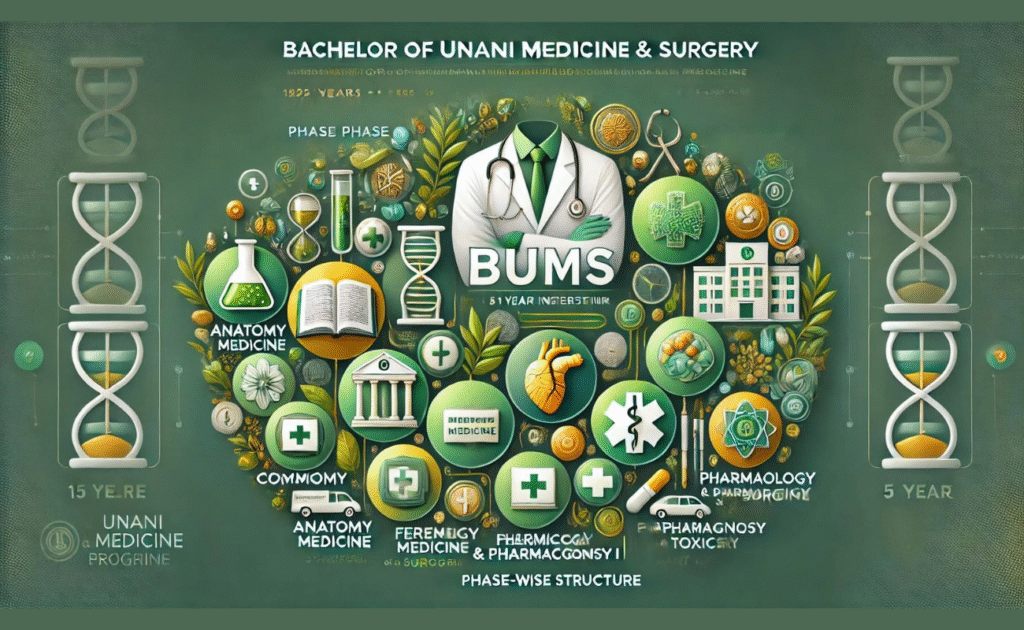
So what is this thing? BUMS full form is Bachelor of Unani Medicine and Surgery. It is a five and a half year undergraduate medical degree that focuses on the Unani system of medicine. This system has its roots in ancient Greece and was later developed by Arab and Persian scholars. Today it is widely practiced in India, Pakistan, Bangladesh, and several Middle Eastern countries.
The course is structured as four and a half years of academic study followed by one full year of compulsory internship. During this time you learn everything from anatomy and physiology to Unani pharmacology, surgery, and patient care. The degree is recognized by the Central Council of Indian Medicine, which now operates under NCISM, and falls under the AYUSH Ministry of the Government of India. The World Health Organization has also included Unani medicine in its global classification system. So yes, this is a legitimate medical degree. After completing it, you can legally practice as a Unani doctor.
Which Field Does BUMS Serve Best?

Now here is the real question. Does BUMS lead to hospital jobs, research, or private practice?
The honest answer is this. Clinical healthcare is where BUMS truly shines. Sure, graduates can enter research, teaching, pharmaceutical companies, and wellness consulting. You can work as a lecturer in Unani colleges or join a herbal medicine company. But if you ask anyone who actually completed this degree, they will tell you straight up that becoming a practicing Unani physician is the main goal. BUMS graduates work in government AYUSH hospitals, private Unani clinics, and even start their own practice.
Research and academia are solid side paths. But patient care and treatment using Unani principles is clearly the star of the show. Teaching and industry roles feel more like bonus options. If you are someone who wants to treat people using natural and holistic methods, BUMS probably feels like it was made keeping you in mind.
Why Do People Keep Coming Back to BUMS?
There are a few solid reasons why students choose this degree year after year.
First, it is a proper doctor degree. You get the title of doctor. You can prescribe Unani medicines. You can perform minor surgeries. That professional identity matters.
Second, the competition is lower than MBBS. While MBBS seats are extremely limited and require sky high NEET scores, BUMS offers a more achievable path into medical science for many students.
Third, the demand for natural and holistic medicine is growing fast. People are tired of side effects from allopathic drugs. They want herbal remedies, dietary healing, and lifestyle based treatments. Unani medicine offers exactly that.
Fourth, government support is strong. The AYUSH Ministry actively promotes traditional medicine. New Unani hospitals and wellness centers are opening across India.
Fifth, it is affordable. Government colleges charge as low as seventy thousand rupees for the entire course. Even private colleges are cheaper than MBBS private institutions.
Sixth, global recognition is increasing. Unani medicine is accepted in many countries, especially in the Middle East and South Asia. That opens doors for international practice and collaboration.
How to Get Into BUMS
Getting into BUMS is not complicated but it requires planning.
You must have passed 10+2 with Physics, Chemistry, Biology, and English. You need at least fifty percent marks in your science subjects. For reserved category students, the requirement is usually forty percent. You must also be at least seventeen years old.
The biggest gate is NEET. You have to clear the National Eligibility cum Entrance Test and score enough to qualify for AYUSH counseling. After NEET, you register for counseling conducted by AACCC for all India quota or your state authority for state seats. You select your preferred colleges. Based on your rank, you get allotted a seat. Then you submit your documents, pay the fees, and join the course.
Fees vary wildly. Government colleges like Ajmal Khan Tibbiya College at AMU Aligarh charge very little. Private institutions can go up to twelve lakhs for the full program. Always check if the college is recognized by NCISM before you pay anything.
The Challenge and Reality Side
Let us now address the part no one enjoys hearing, but everyone must know. BUMS is not a shortcut. It is not a consolation prize for failing to get MBBS. It is a rigorous medical degree that demands five and a half years of serious study.
You will study subjects in Arabic and Urdu terminology because the original Unani texts use those languages. You will memorize herbal properties, learn complex diagnostic methods, and spend long hours in clinical training. The internship is not optional. It is compulsory and intense.
Another reality is social perception. Some people still see Unani as secondary to allopathic medicine. That mindset is slowly changing thanks to government promotion and patient success stories, but it exists. You need thick skin and genuine passion for this field.
Also, the market has fake and unapproved colleges. If your institution is not recognized by the proper authorities, your degree is worthless. You cannot get government jobs. You cannot register as a doctor. My advice? Verify the college status on the NCISM website. Do not trust agents who promise direct admission without proper paperwork. Have a clear career plan before you enroll.
Alternatives to Think About
If you’re not sure, all this seems like too much of a commitment. Luckily, there are other ways to go when it comes to the medical field.
Allopathic is MBBS and the most conventional medical degree. BDS is a course in Dental surgery. The main emphasis of BAMS is on the Ayurvedic healing system, an ancient system of healing in India. A book on Homeopathy by BHMS. Naturopathy & Yoga are included in the scope of BNYS. They all have their own curriculum, ideas and career trajectory.
BUMS is the choice for you if you want the healing of Greek and Persian traditions, along with the science of herbs. For those who are looking for the Indian traditional roots, BAMS may be more appropriate. If you are interested in modern surgery and emergency medicine, then go for MBBS. Other healthcare career options that don’t involve a medical degree taking as long are also great, such as nursing, physiotherapy, and pharmacy.
Final Word
At the end of the day, BUMS is popular for one simple reason. It gives students a real medical career through traditional and holistic healing. The full form, Bachelor of Unani Medicine and Surgery, represents centuries of medical wisdom blended with modern science. Clinical practice is clearly its strongest suit, though research and teaching are solid options too. The degree is affordable, government-backed, and globally recognized.
However, it is important to be savvy about it. Only select reputable colleges. Pass the NEET exam through hard work. Understand that this is not an easy backup plan. A challenging course that deserves respect. So if you’re a true believer in natural healing and patient care, BUMS may be one of the best things you ever do.
The end-point in all medical trails is the same, whether you pick BUMS or other medical route. Improve people’s health, alleviate their suffering and have a good career. Just be sure to do it with all commitment and the correct information.
Read More: UPSC Full Form: What is UPSC, Meaning, Exams & More