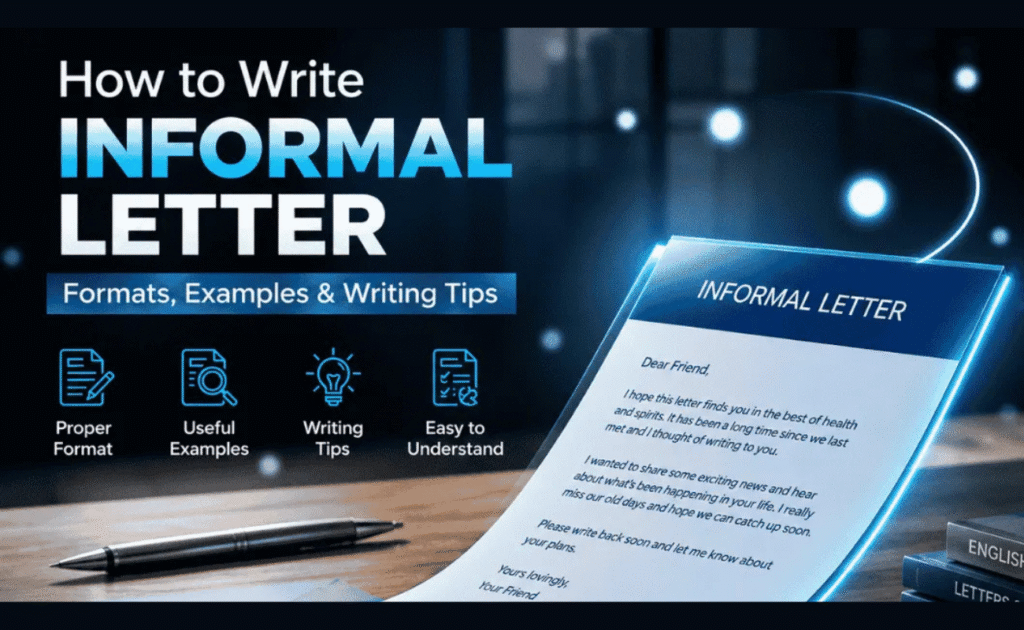
You don’t have to dread writing a letter to a friend or family member. An informal letter is a personal and friendly letter to share information, invite someone to visit, or just to catch up with a loved one. It does not have formal rules or business language like formal letters.
This article will provide you with the proper format, writing guidelines step by step, a sample letter, and answers to frequently asked questions, so you can write a letter that is warm and natural and you’ll have the confidence to do so.
What Is an Informal Letter?
Informal letter is a personal letter addressed to a person you know well and have written to before, like a friend, cousin, sibling or parent. It’s written in a relaxed, everyday style of language like you would use in a conversation.
The main difference between informal and formal letter is the tone of the letter. A formal letter is written in a business context, to apply for a job, or to make an official request, and must be polite and well-structured. A letter, however, that is informal is relaxed and personal. No need to worry about sounding “professional” when sharing jokes, discussing with the family or talking about everyday life.
Typically, this style of letter is used when an individual wants to convey good news, invite someone to an event, inquire about the health of a person, or simply stay in touch when unable to meet in person.
c An Informal Letter (Step By Step)
Step 1: Start with a Warm Greeting
The first line of the letter creates the tone. The greeting must be simple and friendly since you are writing to someone who is familiar to you. You could use:
- Hi [Name],
- Hello [Name],
- Dear [Name],
- Hey [Name],

Opening the letter with “Hey Maya, how have you been?” makes it feel very personal and heartfelt.
Step 2: Write the Personal Email Message
Following the greeting, include a line that demonstrates that you are really considering the person. This makes the letter appear more sincere as opposed to hurried. Some useful phrases:
- Hope that you are doing well!
- I have been coming up with ideas for writing to you.
- I’m sending you a quick email.
- It has been long time since we spoke!
Step 3: Share Your Message or Updates
This is the body of the letter, where you discuss the purpose of your letter. It might be news, invitation, question or status updates. Avoid using long, formal sentences; write as you would speak. To connect your ideas together, you can use the following transitions:
- By the way…
- Guess what?
- What a thing to happen, you won’t believe me!
- I wanted to let you know that…
Step 4: Close Warmly
Close the letter in a friendly manner that will make the reader feel good and excited to respond. Typical closing statements are:
- Take care,
- Lots of love,
- Best wishes,
- Talk soon,
- In anticipation of your reply,
Read Also: BDS Full Form in Medical: Salary, Scope, Govt Jobs & Course Details
Informal Letter Format (Structure Breakdown)
Although the letter is informal, it has a simple structure:
- Sender’s address: Written at the top left. Please give only your house number, street, city and PIN code. Do not add your name here.
- Date: Written just below the address, on a separate line.
- Salutation: The word used to greet a person, e.g. Dear Rohan,
- Body: Three or four short paragraphs, usually the opening, the main message and the closing thought.
- Close of an email: The final phrase or sentence of an email, such as “With love,” or “Your loving friend.
- Signature: Your name, without a last name.
- P.S. (optional): If necessary, an additional note that is placed after the signature.
Sample Informal Letter
123 Green Park Colony Lucknow, UP
14th March, 2026
Dear Aditi,
Looking forward to a happy and healthy letter! I wanted to write to you since our last video call, but there’s been a lot going on in my life lately.
Did have some great news, I got to begin taking some weekend painting classes, which I’ve been wanting to do for a long time. I did a few of the first ones, but I need to practice more to get them right. Even sold one of my small canvas paintings to a neighbour which made my whole week!
What is your experience been like with your new career? I recall after the initial few weeks you were stressed out. I hope your group is nice and the work isn’t too difficult. Please do write back and tell me all.
Be careful and speak soon,
Your sweet friend Neha.
Informal Letter Format of Students Class 9 / School Exams
Writing an informal letter usually appears in the initial learning of writing in the first place for many students, given the context of school exams, particularly in Class 9 English papers. Here are some things to remember:
- Word limit: 100–120 words (may differ from board to board as per their requirements).
- Paragraphs: Use three short paragraphs: Opening, body, closing.
- Address: Never write your name in the sender’s address.
- Salutation: Do not use the term ‘Respected’.
Quick Exam Check List:
- Sender’s address without your name
- Correct date format
- Write out the greetings with a comma in between.
- Clear purpose in the first paragraph
- Warm, appropriate closing
- In the signature: First name only
- Word count (if there is a limit)
Informal Letters: Common Mistakes
These are some common mistakes that can result in losing marks or cause awkwardness in even simple letters:
- Using Respected: This word is only used in formal letters. Use “Dear” or “Hi” for an informal letter.
- Don’t put your name in the address: The address of the sender cannot contain your name.
- Stilted writing: Don’t use language that’s like “I’m writing to tell you. Do the opposite then; Keep it natural.
- Violating word limits: When exams include a word limit, it is important not to go over or under the limit as this can impact score.
- Avoiding the purpose: Let readers know right away why you are writing.
Final Word
The structure of an informal letter is simple to understand, and once you master the basics of the elements of an informal letter, it is easy to learn how.Once you grasp the essential components of an informal letter, you can easily learn the structure of an informal letter: address, date, salutation, body, closing, and signature.
However, the “magic” of an informal letter is the enthusiasm and candidness of the message itself. Be sincere and direct, keep the language simple, and use your own voice, whether you are writing for a class assignment or a letter to a friend or family member. A bit of practice and writing a heartfelt letter will eventually be as natural as talking to a friend.
FAQs
1.Which is the proper format for an informal letter?
An informal letter contains an address, date, friendly greeting, informal body, and a closing, such as “Take care” or “Take care of yourself.
2. What is the word limit for an informal letter in exams?
Most school boards are looking for approximately 100-150 words. CBSE normally requires 100-120 words, some boards it can be slightly more.
3. Is Respected acceptable for an informal letter?
No, respected is used only in formal letters. Use informal greetings such as “Dear” or “Hi” or “Hello” and then the name of the person in an informal letter.
4. What are some appropriate closing phrases for an informal letter?
Common closings are: “Take care,” “Lots of love,” “Best wishes,” and “Looking forward to hearing from you.
5. Should I enter my name in the sender’s address?
No. In an informal letter, your house number, street, city and PIN code should only be included in the sender’s address. The name is only on the letter at the end (in the signature).
Read More: NID vs UCEED: Which Design Entrance Exam Should You Choose? | Creativedge Guide