Sports naming debates rarely generate genuine passion. Ping pong versus table tennis is a notable exception — a distinction that serious competitive players defend with intensity that casual observers find disproportionate until they understand what the terminology actually signals. These aren’t simply two names for identical activities. They represent different relationships with the same fundamental game — one recreational and social, one competitive and technically demanding in ways that the casual version never approaches.
Dbbet engages with racket sports across global markets — recognizing that understanding ping pong, how to play ping pong, and the distinctions between recreational and competitive table tennis provides essential context for appreciating one of the world’s most widely practiced athletic disciplines. More people play table tennis than almost any other sport globally — a reach that reflects genuine accessibility combined with extraordinary competitive depth.
The Naming Question
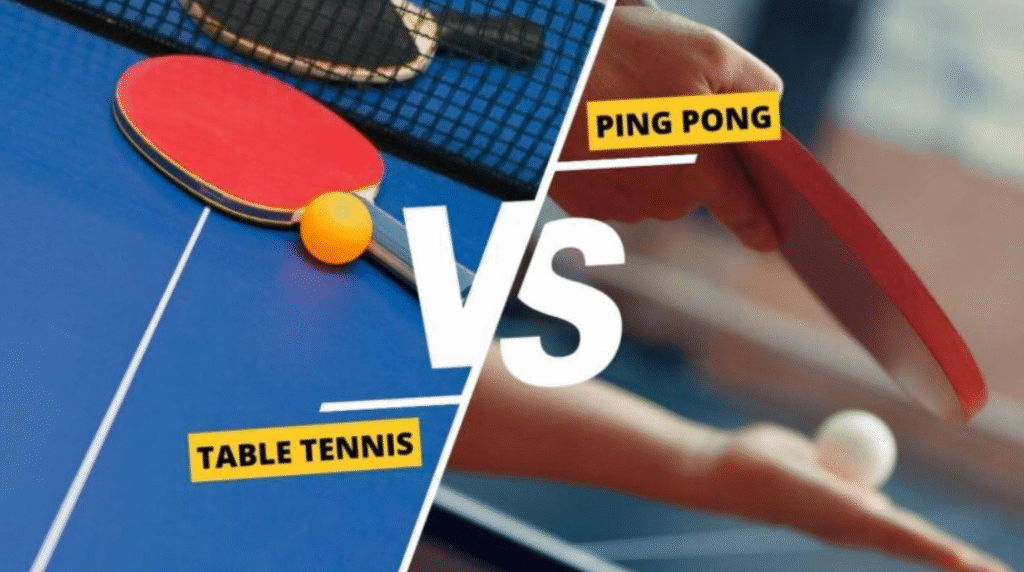
The distinction between ping pong and table tennis carries more weight than pure semantics. Table tennis is the official Olympic sport governed by the International Table Tennis Federation — a competitive discipline with standardized equipment regulations, professional tour structures, and technical demands that separate elite players from recreational participants as completely as golf separates Sunday players from tour professionals.
Ping pong, by contrast, functions as the colloquial term for recreational play — basement games, office tournaments, and the casual competitive context where enjoyment matters more than technical precision. Interestingly, Ping-Pong is also a registered trademark owned by various companies across different markets, adding commercial complexity to what might otherwise be purely linguistic distinction.
Origins: Victorian England’s Parlor Game 🏛️
Table tennis emerged from Victorian England’s upper-class recreational culture during the 1880s — affluent households creating indoor versions of lawn tennis during winter months when outdoor play was impractical. Early versions used improvised equipment whose variety reflected the absence of any standardizing commercial production.
Books stacked across dining tables served as nets. Rounded book covers or cigar box lids became paddles. Golf balls, rubber balls, and various improvised projectiles served as the ball before celluloid’s specific properties were recognized as ideal for the game’s playing requirements. This improvised beginning created a sport whose accessibility remained embedded in its identity long after commercial standardization arrived.
The Jaques of London sporting goods company trademarked “Ping-Pong” in 1901 — the onomatopoeic name capturing the sounds that early celluloid balls made during play. This commercial formalization accelerated the sport’s spread while simultaneously creating the naming complexity that persists today.
How to Play Ping Pong: The Fundamentals 🏓
Understanding how to play ping pong begins with the table — a 9-foot by 5-foot rectangular playing surface standing 2.5 feet high, divided by a net standing 6 inches tall. This compact playing environment creates the rapid exchange pace that distinguishes table tennis from all other racket sports — reaction times measured in fractions of seconds rather than the longer intervals that larger courts allow.
Serving initiates each rally — the server must toss the ball visibly upward at least 16 centimeters before striking it, ensuring the opponent can anticipate the serve’s direction. The ball must bounce on the server’s side before crossing the net and bouncing on the receiver’s side — a double bounce requirement that prevents direct service winners and ensures rallies develop beyond single shots.
Points are scored when opponents fail to return the ball legally — hitting the net, missing the table, or allowing the ball to bounce twice. Games are played to 11 points, win by two, with service alternating every two points — a rotation system creating continuous tactical variation that prevents serving advantages from compounding across extended periods.
Equipment: More Technical Than It Looks 🔬
Recreational ping pong game equipment and competitive table tennis equipment occupy surprisingly different technical spaces despite superficial similarity. Understanding equipment differences reveals how completely serious table tennis has developed beyond its casual origins.
Competitive paddles consist of a wooden blade — whose specific wood species combinations affect vibration dampening and speed characteristics — covered by rubber sheets whose properties determine how spin is generated and received. The International Table Tennis Federation regulates rubber thickness, surface characteristics, and blade composition through detailed specifications that recreational equipment ignores entirely.
The ping pong ball itself has evolved — transitioning from celluloid to plastic construction in 2015 in a change that affected playing characteristics enough that professional players required significant technical adaptation. Ball diameter, weight, and roundness tolerances are all specified within competitive regulations that recreational play never requires participants to consider.
Spin: The Game Within the Game
No element of competitive table tennis separates skill levels more completely than spin — the specific rotation applied to the ball through racket angle and brushing contact that fundamentally alters how the ball travels through air and behaves after bouncing. Understanding spin transforms table tennis from a game of hitting the ball back into a game of controlling physical forces that opponents must read and counter simultaneously.
Topspin creates forward rotation that accelerates the ball’s descent after bouncing — allowing aggressive shots to clear the net safely while still landing on the table. Backspin creates reverse rotation that causes the ball to decelerate and stay low after bouncing — making aggressive returns more difficult and creating opportunities for opponents to mis-hit into the net.
Sidespin combines with topspin and backspin to create curved trajectories that sophisticated players exploit for deceptive serves and unpredictable returns. Reading spin correctly and adjusting racket angle accordingly represents the fundamental technical challenge that separates recreational players from genuine competitive practitioners.
China’s Dominance: A Sporting Phenomenon 🌍
Any serious examination of table tennis must engage with China’s extraordinary dominance — a competitive phenomenon that represents sports development excellence at its most systematic and sustained. Chinese players have won the majority of Olympic gold medals since the sport’s 1988 Olympic introduction, producing champions whose technical sophistication sets global standards that other nations spend careers attempting to match.
The Chinese national team’s development system combines early talent identification, specialist coaching from young ages, and competitive volume that exceeds what other nations’ programs provide. Domestic Chinese competition features more genuinely world-class players competing regularly against each other than most nations have ever produced across entire sporting histories.
This dominance has created interesting governance dynamics — the International Table Tennis Federation actively implementing rules changes specifically designed to reduce Chinese advantages and create more competitive international balance. Ball composition changes, service rule modifications, and equipment regulations have all been partly motivated by competitive balance considerations that Chinese dominance made institutionally urgent.
Olympic Table Tennis: The Highest Stage
Table tennis’s Olympic program has evolved significantly since Seoul 1988 — competition formats expanding, team events added, and the competitive field genuinely broadening as development programs outside China have produced more consistently world-class performers. The team competition format, introduced at Beijing 2008, created collective competitive dynamics that individual events don’t generate — national pride amplified through shared performance rather than individual achievement alone.
Olympic table tennis’s pace and technical level genuinely surprises audiences encountering elite play for the first time — the speed of professional exchanges, the spin variation between consecutive shots, and the physical demands of sustained elite play all exceeding what recreational familiarity with the game suggests should be possible.
Health Benefits and Global Accessibility
Table tennis’s health profile combines cardiovascular engagement, fine motor development, and the specific cognitive demands of rapid decision-making under time pressure that neuroscience research increasingly identifies as genuinely brain-protective across aging populations. Studies suggesting table tennis’s specific benefits for coordination maintenance and cognitive function have accelerated its adoption in senior health contexts globally.
Accessibility drives global reach more completely than competitive excellence alone. A ping pong game requires a table, paddles, and balls — equipment available at price points that make participation genuinely accessible across income levels that tennis, golf, and other racket sports exclude through equipment and facility costs. This democratic accessibility has produced a global player base estimated between 300 and 900 million people — numbers that make table tennis genuinely competitive for the title of world’s most widely played sport.
The Recreational-Competitive Bridge
What makes ping pong and table tennis genuinely interesting as a combined phenomenon is how completely the recreational and competitive versions share essential elements while diverging in execution quality. The rules are identical. The equipment is structurally similar. The fundamental challenge — returning the ball across the net onto the opponent’s table — never changes regardless of skill level.
This continuum between casual and elite creates entry points at every skill level without requiring participants to choose between recreational enjoyment and competitive seriousness. Office ping pong players and Olympic champions are playing recognizably the same game — separated by technical sophistication that years of dedicated practice develop but not by any fundamental rule or equipment incompatibility that prevents one from understanding and appreciating the other.