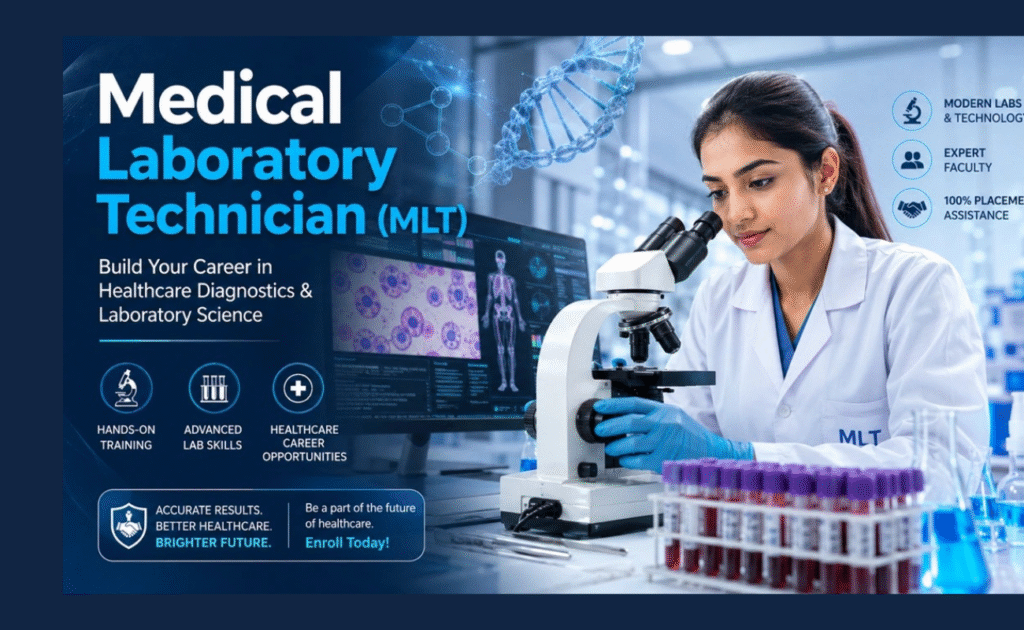
Let us get the name out of the way first. MLT full form is Medical Laboratory Technician. Some people also say Medical Laboratory Technology when they are talking about the course itself. But when you see MLT as a job title, it almost always means Medical Laboratory Technician.
These are the people who work behind closed doors in hospitals and diagnostic labs. You never see them when you visit the doctor. But every time your doctor asks for a blood test, a urine test, a thyroid test, or anything else that involves sending your sample to a lab, an MLT is the one who actually does the work.
They collect your sample. They handle it properly so it does not get contaminated. They run it through machines. They look at it under microscopes. They check for bacteria, viruses, sugar levels, blood cell counts, and basically everything that tells the doctor what is wrong with you. Without MLTs, doctors are just guessing.
What Does an MLT Actually Do
An MLTs day is spent in the lab doing practical work. They collect blood and urine samples. They operate lab equipment like auto analyzers, microscopes, and centrifuges. They run tests in biochemistry, microbiology, hematology, pathology, and immunology.
They also maintain lab records, follow safety protocols, and make sure equipment is working correctly. One small mistake can lead to a wrong diagnosis. So accuracy is everything.

Some MLTs specialize in one area. A blood bank technician only works with blood samples. A microbiology technician deals with cultures and bacteria. But most MLTs handle a bit of everything.
How to Become an MLT
There are different ways to enter this field.
The shortest route is CMLT, Certificate in Medical Laboratory Technology. This takes 6 months to 1 year. You can join after 10th or 12th. It teaches basic lab skills. But the scope is limited.
Most good hospitals prefer at least a diploma
Then there is DMLT, Diploma in Medical Laboratory Technology. This is a 2 year course. You need 12th with science subjects. DMLT is popular because it is short, affordable, and job ready. You learn pathology, microbiology, biochemistry, and blood banking. Plus you get practical training in real hospitals.
The best route is BMLT or B.Sc MLT, a 3 to 4 year degree. You need 12th with Physics, Chemistry, and Biology. Some colleges have entrance exams. Others admit based on 12th marks. The good news is NEET is not required for most MLT courses. So if NEET stressed you out, this is a much easier entry into the medical field.
BMLT gives you deeper knowledge, better practical exposure, and more career options. You also do an internship in a hospital lab.
Read Also: Exploring Adderall Alternatives: Safe & Effective ADHD Treatment Options
Subjects You Will Study
You will study human anatomy and physiology, biochemistry, microbiology, pathology, hematology, immunology, blood banking, and clinical testing procedures. You will also learn how to handle lab equipment and follow safety standards.

But it is not just books. A huge part is practical training. You will learn how to draw blood, prepare slides, use microscopes, and operate diagnostic machines. This hands on experience is what makes you employable.
Career Scope After MLT
The demand for lab technicians is massive and growing. Every hospital needs a lab. Every diagnostic chain needs technicians. Blood banks need them. Research centers need them. Even pharmaceutical companies hire MLT graduates for quality control.
You can work as a lab technician, medical lab technologist, pathology technician, blood bank technician, research assistant, or quality control analyst. With experience, you can become a lab supervisor or manager.
Government jobs are also available. AIIMS, ESIC hospitals, railway hospitals, and state hospitals regularly recruit MLT professionals. Government jobs give stability and long term benefits.
MLT Salary in India
If you finish DMLT, freshers can expect around 10,000 to 20,000 rupees per month. With BMLT, freshers start at 15,000 to 30,000 per month. That is roughly 2.5 to 4 lakhs per year.
After 3 to 5 years, you can reach 3.5 to 5.5 lakhs per year. Senior professionals earn 5 to 8 lakhs per year. Higher studies like M.Sc MLT can push your salary further.
Higher Studies After MLT
BMLT can be done after DMLT. Following BMLT, M can be performed.Sc in Medical Laboratory Technology, M.Sc in Microbiology, M.A masters degree in Biochemistry (Sc) or other masters program. There’s also the option of a PhD after. Advanced studies present the possibility of becoming a teacher, researcher and lab director.
Is MLT a Good Career Choice

MLT is an excellent degree for anyone who likes science, enjoys hands-on activities, and desires a healthcare career that is not as stressful as a doctor. The course is much shorter than MBBS. It costs less. Earlier earnings start. And the employment market is strong.
You do not get the same salary as a doctor. But you also do not deal with the same stress or long hours. You work in a lab, you go home, and you have a life. For many people, that balance is worth it.
Final Word
MLT full form is Medical Laboratory Technician. These professionals handle diagnostic testing in hospitals and labs. You can become one through a certificate, diploma, or degree after 12th with science. NEET is not needed for most courses. The job involves collecting samples, running tests, operating equipment, and maintaining accuracy.
Career options include hospitals, diagnostic labs, blood banks, and pharmaceutical companies. Starting salary is around 2.5 to 4 lakhs per year but grows with experience. If you want a practical, affordable, and in demand healthcare career, MLT is worth considering. Just pick a good college with proper lab facilities because that is what will make you job ready.
Read More: What Is the Best Course After B.Com? A Simple Guide for Commerce Graduates