
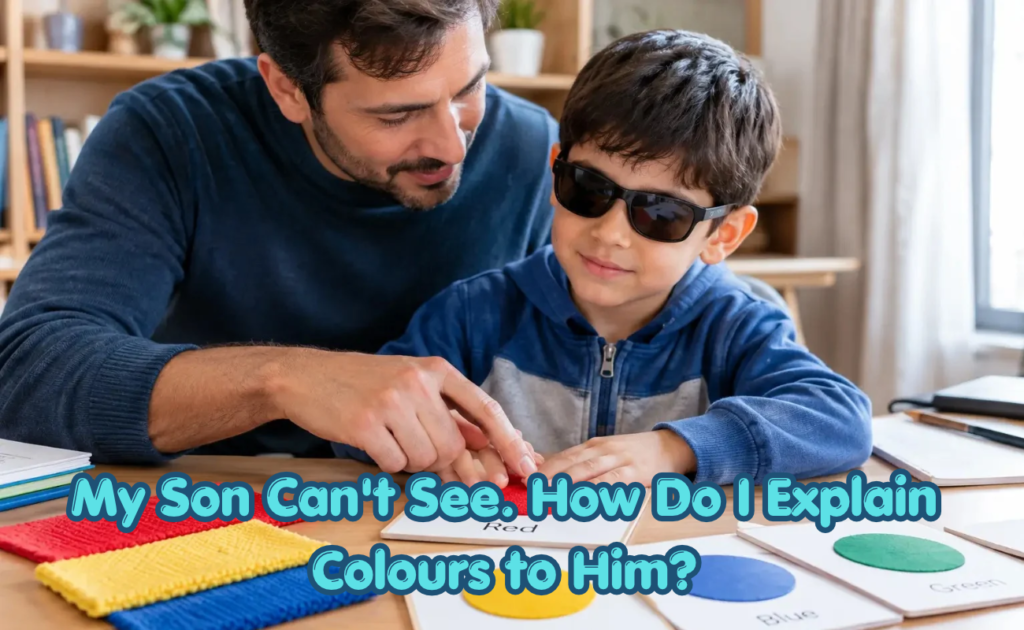
When the question is “my son can’t see. how do I explain the colours to him?” It is love. Colours are everywhere. We mention them in stories and songs and make them the subject of school lessons, so of course you’ll have concerns your child is missing out.
The good news is coloured is more than what we see. Can be learnt by words, touch, smell and feelings. He doesn’t need to get mad like you do. All you have to do is explain to him what colour is. Here are some easy and soothing steps to begin.
Start by Talking About Colours Naturally
Avoid using an avoidance strategy in relation to colour words. Use them in regular conversations such as “Wear your blue jumper” or “This banana is yellow. Your son discovers that colour is a characteristic of objects, like size, shape or smell. It is also good for him to be able to participate. He can reply if asked by a friend, “What colour is your bag? He knows the details if a story refers to a green forest.
Explain Colour as Useful Information
To those who still think they don’t know how to teach him colours, begin by telling him what colours tell. Red is usually a warning colour, temperature or love. Green is a call to nature and “go. The blue color represents water, sky and calm. Yellow brings to mind sunshine. White may be snow or milk and black is frequently night. These meanings may vary from culture to culture so consider them common rather than set rules.
Use the Senses He Already Trusts
Your son is experiencing the world through the senses of touch, smell, taste, sound and temperature. Build bridges with these to colour. Red may feel warm, like hot chocolate, or a sunny windowsill. Blue can be cool, as in water, or as in smooth stones. Green smells fresh (minty or wet grass). White is soft, both like cotton or clean sheets.
Let Him Build His Own Colour Meanings
Your son might associate colours to varying objects from you; that’s ok. Perhaps blue is like piano music or yellow is like laughter. Allow him to retain these ideas. Ask open-ended questions like “What does red make you think of?” or “Which colour does sound the happiest? These questions make colours more of a game than a test.

Use Real Objects Instead of Long Explanations
Long explanations don’t work as well as real things. In the kitchen, discuss red tomatoes, orange carrots and brown bread. Talk about the green leaves and yellow flowers in the garden. When dressing up, say the colours of his clothes. Label objects with a raised sticker or similar textured object if he reads braille, so that he can distinguish his red cup from his blue folder.
Teach Colour Through Stories and Emotions
The use of colour to create a mood in stories. Grey skies can appear quiet or sad. The feeling of royalty is best captured by a golden crown. Read together with a pause and explanation. You can say, “The writer selected grey as it makes people think of the rainy, quiet days. This opens his mind to the notion that colour is a component of story and emotion.
Be Honest About What Can’t Be Translated
The answer to “what does it feel like to see red” is, “I can’t really tell you. Even blind people can’t fully comprehend how he hears a person’s voice or hears small sounds. There are multiple ways of gathering information. Trust is established by being honest.
Avoid Making Colour Feel Like a Loss
Avoid saying anything deplorable or pitying about colour. Your son need not feel that colour is a world he can’t go into. Many people see colour with their eyes but we can all learn what colour means. That message tells him that there is colour in his too.
Final Word
Remember that you don’t need to have a perfect answer if you continually ask yourself, “my son can’t see. how do I explain colours to him? Continue the discussion. Assign colours to objects, emotions, sounds and narratives, and allow him to think the thoughts, too. As he learns and experiences more, he can create his rich picture of colour using language.
FAQs
1.Can a child who is blind comprehend colour?
Yes. He can learn colours as language, information and association. He is able to learn the names of people and where they are even if he doesn’t actually see them.
2. When should I start talking about colours?
Start early. Use colour words in the language of the day, from an early age, for example, “your yellow cup. Pupils learn words by repeating, so just don’t wait for him to ask.
3. How can I describe red to a blind child?
Connect red to warmth and energy, such as hot soup, ripe strawberries, drum beat, etc. Describe that lots of people have red associated with forceful emotions like love or risk.
4. Should I not use color terms in the vicinity of him?
No. If you avoid them colour is out of bounds. He naturally understands and follows stories, answers questions, and chats with sighted friends when reading with the use of colour words.
5. What aids are used for teaching colours to blind children?
Assistive technology includes tactile colour books, braille labels, textured markers, scent items and music links.
Read More: How Many Ounces Is a 750 ml Bottle?