
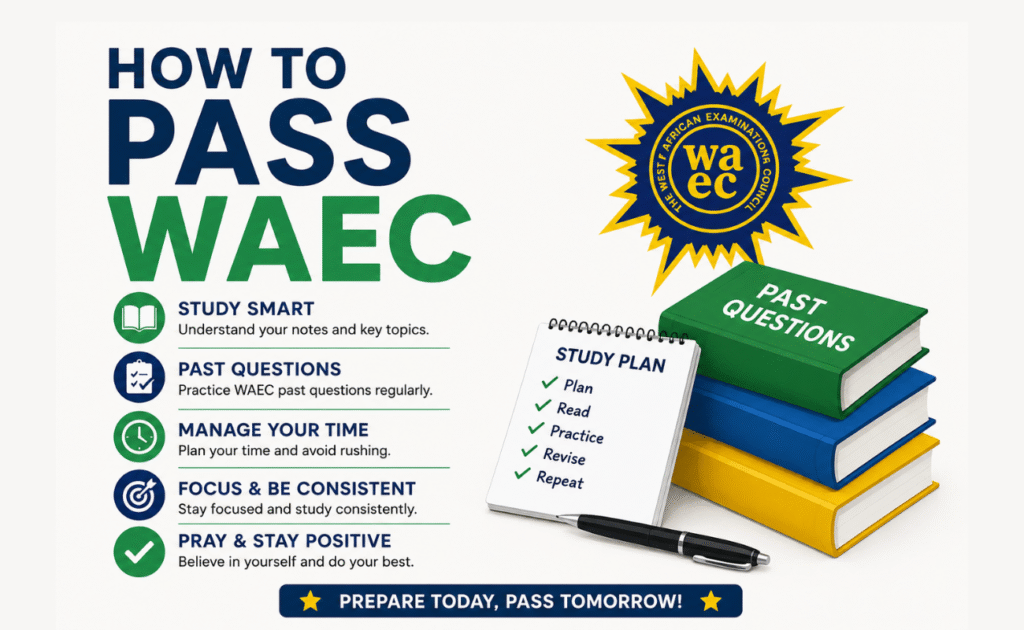
If you are getting ready for WAEC and you want to understand how the Mathematics paper looks, checking the 2018 questions is one of the smartest things you can do. WAEC does not change its style every year. The topics repeat, the pattern repeats, and even the way the questions are worded stays almost the same. So once you go through the 2018 Mathematics questions and answers properly, you will notice the same tricks showing up in newer papers too.
This article will walk you through what the 2018 WAEC Mathematics paper covered, show you some real sample questions with their answers, and give you simple tips on how to use past questions to prepare well.
Why the 2018 Mathematics Paper Still Matters
A lot of students make the mistake of only reading questions from the most recent year and ignoring older ones. That is not a good idea. WAEC recycles the same topics almost every session: algebra, geometry, mensuration, trigonometry, statistics, and simple arithmetic problems like ratio, percentage, and variation. The 2018 paper is a good example because it contains almost every major topic that WAEC likes to test students on.
Working through it will help you in two ways. First, you get used to the exact wording WAEC uses, which can be confusing if you are seeing it for the first time in the exam hall. Second, you build speed, because Mathematics is a subject where time management decides whether you finish the paper or not.
How the WAEC Mathematics Paper Is Structured
The WAEC Mathematics exam usually comes in two parts:
Paper 1 (Objective): This is the multiple-choice section. You get 50 questions and you are expected to pick the correct option from A to D. This paper tests a wide range of topics in a short amount of time, so it rewards students who know their basic formulas well and can calculate fast.

Paper 2 (Theory/Essay): This is where you show your working. You are usually asked to answer a number of questions from Section A (which is compulsory) and a few more from Section B (where you choose which ones to answer). This paper rewards students who understand the steps involved in solving a problem, not just the final answer.
Let’s look at real examples from the 2018 paper so you can see exactly what to expect.
Sample Objective Questions from 2018 with Answers
Question 1: Simplify √108 + √125 − √75
To solve this question, you have to break each number down into its simplest surd form. So, now do it: √108 becomes 6√3, √125 becomes 5√5 and √75 becomes 5√3. When you combine them: 6√3 − 5√3 + 5√5 gives you √3 + 5√5.
Answer: √3 + 5√5
Question 2: Evaluate (64^½ + 125^⅓)²
Here is the thing: 64 raised to the power of a half means the square root of 64, which is 8. And 125 raised to the power of a third means the cube root of 125, which is 5. And now add them together: 8 + 5 = 13. Then you need to square the result, so the final result is: 13 × 13 = 169.
Answer: 169
Question 3: If y varies inversely as the square of x, and x = 3 when y = 100, find the equation connecting x and y.
Inverse variation means y = k/x², where k stays constant. Substitute the given values: 100 = k/9, so k = 900. That means the equation is yx² = 900.
Answer: yx² = 900
These examples show why understanding the method matters more than memorising answers. If you only memorise “the answer to question 2 is 169,” that knowledge is useless the day WAEC changes the numbers. But if you understand how surds work, or how powers and roots relate to each other, you can solve any similar question no matter how it’s dressed up.
A Sample Theory Question from 2018
Theory questions in 2018 tested practical topics like depreciation, which many students find tricky. Here is a simplified version of one that appeared:
Question: A car was bought for ₦900,000. In the first year, its value dropped by 30%. After that, it lost 22% of its value at the start of each following year. If the car was bought in March 2011, find its value by February 2015 (that covers 4 years).
How to solve it:
Step 1: Get the value after the first year. 70% of 900,000 = ₦630,000 (this is the value after losing 30%)
Step 2: This is for each of the next 3 years; the car loses 22% of its value, which means it keeps 78% of its value each year.
Step 3: Multiply 630,000 by 78% three times in a row (once for each remaining year), then round the final answer to the nearest hundred naira, as the question asked.
This kind of question is really just testing whether you understand percentages and how to apply the same reduction repeatedly. Once you know the pattern, you can handle depreciation questions from any year, not just 2018.
Topics That Came Up Often in 2018
Based on the full set of past questions, these were some of the recurring topics:
- Surds and indices (simplifying roots and powers)
- Word problems involving variation (direct, inverse, joint)
- Number bases (converting numbers between bases like base 4 and base 10)
- Fractions and simplification
- Geometry involving circles, especially angle and chord properties
- Depreciation and simple/compound interest
- Statistics, including mean, mode, and probability
- Graphs, especially quadratic graphs and reading values from them
- Trigonometry, particularly angles of elevation and depression
If you notice, these are not “hard” topics on their own. What makes WAEC Mathematics feel difficult is usually poor time management or weak understanding of the basics, not the actual complexity of the questions.
Tips for Using Past Questions Properly

- Don’t just read, solve. Cover the answer first and try to work out the question yourself. Only check the answer after you’ve attempted it.
- Time yourself. For the objective section, try to answer each question in under a minute. This forces you to think fast and skip the ones that are taking too long, so you can come back later.
- Write out full workings for theory questions. WAEC awards marks for correct steps, not just the final answer. Even if your final answer is wrong, you can still pick up marks along the way if your method is correct.
- Group questions by topic. Instead of going strictly year by year, pull together all the surd questions, all the variation questions, and so on. This helps you notice patterns faster.
- Revisit your weak topics. If you keep struggling with a particular topic like number bases or circle theorems, don’t skip it. Go back to your textbook, understand the rule properly, then return to the past questions.
Final World
The 2018 WAEC Mathematics paper is a solid resource because it covers nearly every important topic in a realistic exam format. Rather than trying to memorise every single answer, focus on understanding how each type of question is solved. That way, whether the numbers change or the wording is slightly different in your own exam year, you will still know exactly what to do.
Keep practicing consistently, work through both the objective and theory sections, and pay close attention to the topics that repeat most often. With steady preparation, WAEC Mathematics becomes far less intimidating than it first appears.
Read More: When the Best Secondary Tuition Centre Starts O-Levels